

Miami, FL
2023
Small (21–50 employees)
Remitian executes tax payments for accounting firms. After a return or estimate is finalized, Remitian submits the payment directly to IRS and state agency portals, captures the confirmation, and records a complete audit trail for every transaction.
This lets a firm offer tax payment as a service to its clients, which most firms do not currently do. They stop at the return, tell the client what is owed and when, and send them to a government portal to pay it themselves. The firm does not touch client funds, and does not want to.
The consequences land on the firm anyway. Clients miss installments, pay the wrong agency, transpose a routing number, or pay late. The notice arrives, the client calls the firm, and staff spend hours reconstructing what happened and cleaning it up. Firms already deliver this service informally, walking clients through portals, confirming payments, and fixing bad payment data. They simply have no system supporting it and do not charge for it.
Formalizing it manually is not realistic. Handling client funds across dozens of federal, state, and local authorities means portal logins, trust accounting, reconciliation, and liability most firms will not absorb. Remitian is the infrastructure that removes that barrier. The firm schedules and approves. Remitian executes, validates, and confirms, and funds move through a regulated flow the firm does not have to build or hold.
What changes for the firm is the shape of the relationship. Payment becomes a service the firm delivers rather than an unpaid cleanup obligation. The firm can see whether client payments actually completed. Penalty exposure drops because payments are executed and confirmed rather than delegated and hoped for.
The timing matters. The IRS is phasing out paper checks and moving taxpayers onto digital rails. Every client who was mailing a check becomes a client who needs help paying electronically, and that help currently arrives as unbilled staff time.
Remitian processed $100 million in US tax payments across more than 60 jurisdictions in its first US tax season. Firms using Remitian include Aprio and MBE CPAs.
All Firm Sizes
Managing Partner / Firm Owner; Senior Partner (Tax / Audit / Advisory)
Monthly/Annual Subscription
Phone & Email, 24/7 Full Service
2023
Flat annual subscription for the firm, covering unlimited clients, transactions, and users, scaled to firm size
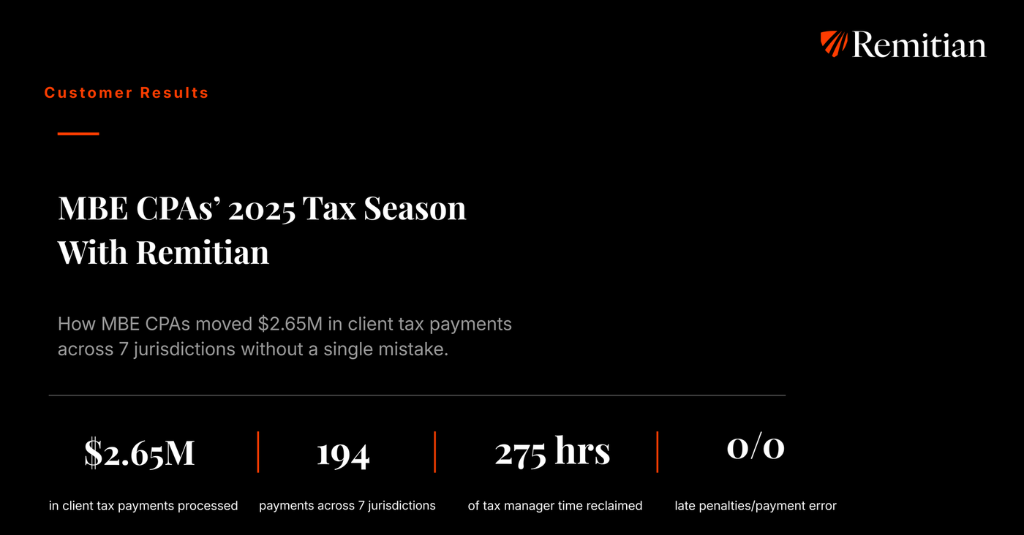
A multi-state firm processed $2.65M in client tax payments across the IRS and six states with zero penalties and 275 staff hours reclaimed.

Remitian CEO Solon Angel on why the profession automated calculating taxes decades ago, but left paying them manual.

Remitian processed $100 million in US tax payments across more than 60 jurisdictions in its first full US tax season.

A walkthrough of how a firm schedules, approves, and confirms client tax payments in one place, with an audit trail on every transaction.
MBE CPAs, Managing Partner
Aprio, CEO
Avail CPA, Principal
Most firms do not, which is exactly the point. The return gets finalized, the client is told what is owed and where to pay, and the firm steps back. What does not step back is the consequence. When a client misses an installment, pays the wrong agency, or transposes a routing number, the notice comes back and the firm absorbs the cleanup. Firms are already delivering this service informally, walking clients through portals and confirming payments. Remitian gives that work a system, so it becomes something the firm delivers deliberately rather than something it absorbs.
No. Payments move directly from the client’s bank account to the tax authority. The firm is not a custodian, there is no trust account to maintain, and no client funds pass through the firm. This is the reason most firms have not formalized payment as a service. Doing it manually would mean handling funds, reconciling them, and carrying the liability that comes with both. Remitian removes that requirement while keeping the firm in control of what gets scheduled and approved.
Yes, and most firms do, though not usually as a separate line item. The common approach is to build it into an existing service tier or retainer and position it as a higher level of service. Some firms name Remitian directly in their engagement letters so it becomes the default rather than an opt in. A smaller number add a flat monthly amount for clients who want the firm handling payments. What works best depends on how your firm prices, so it is worth deciding before rollout rather than after.
Onboarding starts with a training session, and client lists can be uploaded in bulk rather than entered one at a time. Each client completes a one time identity verification and connects a bank account, either manually or through Plaid. After that, setup is done. Most firms start with a defined group rather than the whole book, which keeps the first season manageable and gives the team something to point to internally before expanding.
Failures are almost always insufficient funds or a closed account. When one occurs, the firm and the client are notified within about a day, which normally leaves enough time to correct the bank details and reschedule before the deadline. This is a meaningful difference from the current situation, where a failed payment often surfaces months later as a notice. Successful payments return a confirmation number, so the record shows not only that funds left the account but that they landed at the agency.
Remitian covers federal payments to the IRS and the large majority of states, along with localities including Philadelphia and New York City. Coverage spans balance due, estimates, extensions, amended returns, and notice payments. Additional states and localities are added on an ongoing basis.
Remitian integrates with Aiwyn and Truss, with several additional integrations with major tax and practice management platforms in progress. Where a direct integration does not exist yet, payment details can be extracted automatically from uploaded vouchers rather than keyed in by hand, and an open API is available for firms that want to connect their own systems. The intent is that payment becomes part of the workflow the firm already runs, not another destination.
Remitian is SOC 2 Type 2 certified and holds the licensing required to move client funds. Client banking details are stored by Remitian and are not visible to firm staff, which reduces what the firm has to protect. Every payment carries an audit trail with a confirmation number, so the record of what was paid, when, and to which authority exists independently of anyone’s inbox. Firms including Aprio have taken Remitian through their own security review.
The IRS is phasing out paper checks and moving taxpayers onto digital payment rails. Every client who was mailing a check becomes a client who needs help paying electronically, and that help arrives first as phone calls to the firm. Firms that have a system for this will absorb the shift without adding staff time. Firms that do not will find the work landing on senior people during the weeks they can least afford it.